Seoul subway map, and how to actually ride it
Updated August 2026 · 6 min read
Seoul's metropolitan subway runs over 20 lines and carries millions of riders a day, but it's built around a system that's easy to read once you know it: every line has its own color, every station has a number, and the map itself is free to zoom into as much as you need. This page is the map, plus the details that don't fit on it — which exit to take, when the trains stop running, and the tap-out rule that keeps you from getting overcharged.
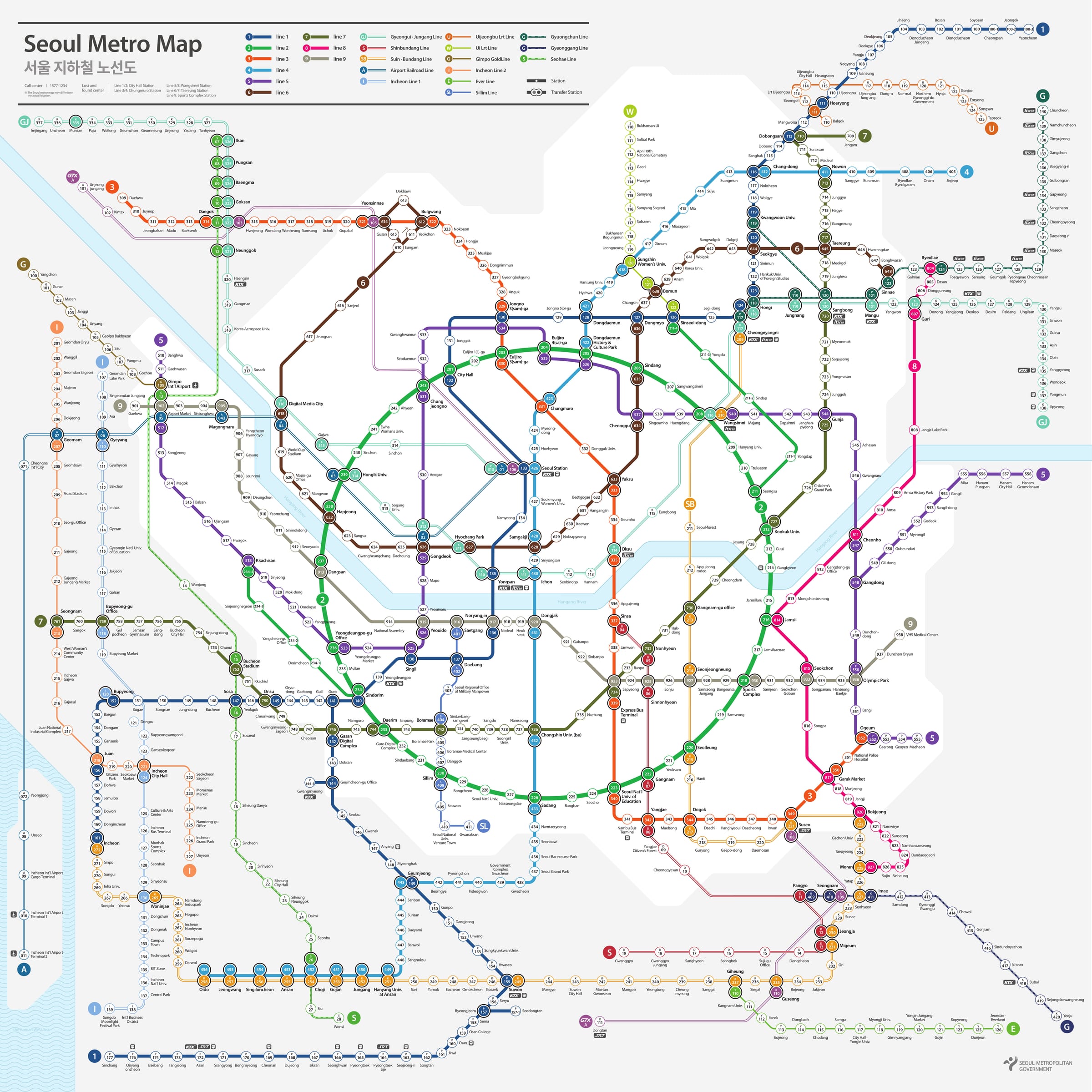
Reading the line colors and station numbers
The core lines a visitor actually rides:
| Line 1 | |
| Line 2 | |
| Line 3 | |
| Line 4 | |
| Line 5 | |
| Line 6 | |
| Line 7 | |
| Line 8 | |
| Line 9 | |
| Shinbundang Line |
Every station also carries a number built from its line — the digits count up as you move along the route, so Gangnam Station on Line 2 is 222, the 22nd station on that line. It's a quick way to gauge distance, and it's what shows up on tickets and signage when the English name alone would be ambiguous between similarly-named stops.
For a version that updates itself as new extensions open, and that can route you door to door, Naver Map and KakaoMap both draw it live — see our guide to setting them up in English.
Tap in, tap out — every single time
Tap your card or phone both when you board and when you get off — the gate on the way out, or the reader by the driver on a bus. Miss the second tap and the system has no record of where you left, so it charges a distance penalty on top of the fare as if you'd ridden to the end of the line. Subway-to-bus and bus-to-bus transfers within about 30 minutes are discounted, but only if both taps happen on every leg — skip one and the transfer discount is gone too. (Need the card itself first? See our guide to buying and charging T-money.)
Picking the right exit
Every exit is numbered, and at a large interchange station there can be more than 15 of them — the gap between the right one and the wrong one can be a ten-minute walk on the surface to correct it. Naver Map and KakaoMap both recommend an exit number once you've entered a destination, so it's worth checking before you climb the stairs rather than guessing from a sign in Korean.
Priority seats
Two seats at the center of each car, usually colored pink, are reserved specifically for pregnant women — Seoul introduced them in 2013 and they're meant to stay empty even on a packed train, not just offered up if asked. Separately, the seats at both ends of every car are general priority seating for elderly, disabled, and injured riders. Both are a real point of etiquette here, not just a suggestion — locals notice when they're taken by someone who doesn't need them.
First and last trains
Trains generally start around 5 to 5:30am and stop around midnight, but the exact time depends on the line, the station, and whether it's a weekend or holiday — there's no single citywide cutoff. Cutting it close late at night is a common way to get stranded; check the live timetable for your specific station in Naver Map or KakaoMap rather than assuming "around midnight" is precise enough.
FAQ
- How do I know which exit to use?
- Every station numbers its exits, and at a big interchange station there can be 15 or more — picking the wrong one can mean a ten-minute surface walk to correct it. Naver Map and KakaoMap both show a recommended exit number for wherever you're headed; check it before you climb the stairs.
- What time does the subway stop running?
- Roughly 5 to 5:30am to around midnight, but the exact first and last train depends on the line, the station, and whether it's a weekend — there's no single citywide time. Naver Map and KakaoMap both show the real timetable for your specific station.
- Are the pink seats really only for pregnant women?
- Yes — Seoul introduced dedicated pink priority seats for pregnant women in 2013, usually two per car, separate from the general priority seating (for elderly, disabled, and injured riders) at both ends of every car. Both are meant to stay empty for the riders they're reserved for, even during a crowded commute.
- Do I need a T-money card to use any of this?
- Yes, in practice — see our guide to buying and charging a T-money card. This page is about reading the map and riding correctly once you've got one.